10 scored on 5 criteria
· last run · Bolt Bench editorial team
A first crossbow is mostly a question of whether you can cock it comfortably and hit what you aim at on day one. Speed numbers matter far less than the makers suggest.
For background before you buy, our blog covers things like cocking safely and choosing between a crossbow and a compound bow, and the FAQ answers the questions first-time buyers ask most.
New to crossbows entirely? Our Crossbow Academy lays the whole path out in order: pick a bow, get the right gear, cock it, sight it in, then take a safe first shot.
Two upgrades change your results more than the bow's spec sheet: the optic and the cutting tip. Our companion guides to the best crossbow scopes and the best crossbow broadheads cover both, including how to match each to your bow's speed.
You are buying for a teenager or a smaller-framed shooter
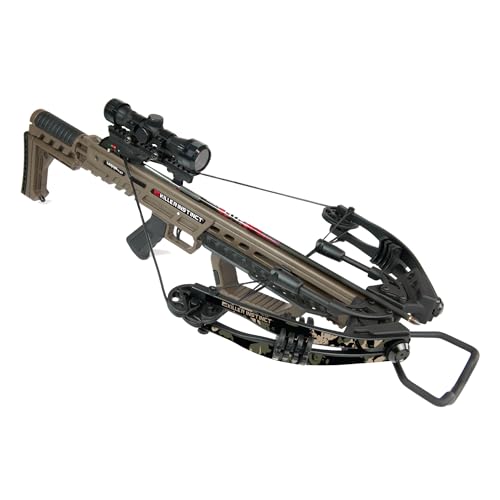
Barnett Recruit XPBuilt around an adjustable stock and the lowest draw in this group. Slower than the rest, and that is the right trade here.Check price on Amazon
CenterPoint Dagger 405Honestly: buy the cheapest complete setup, shoot it for a season, and only then decide what you actually want. Nobody's first bow is their last.Check price on Amazon
The most forgiving package in this group: it ships sighted-in close enough to shoot the same evening, and the multi-reticle scope takes the guesswork out of the first forty yards.
Two things stand out once you look at where the demand actually sits. Accessories - scopes and bolts - are searched more than the bows themselves, because they are what people buy again. And the questions that get asked most are not about speed; they are about range, cocking and whether a crossbow is even the right choice.
That shaped how this site is scored. Ease of cocking carries the same weight as accuracy, and what is in the box counts, because the package is what decides your real total price.
Figures as published by each manufacturer. We have not chronographed these bows ourselves - treat them as claims, and see how little the difference matters in practice.
Package contents as listed by each maker. A bow without a cocking aid is not a cheaper bow - it is an unfinished one, and that gap is priced back in under what you get.
What buyers actually search for, per month
crossbow hunting
14800
crossbow scope
9900
crossbow bolts
8100
crossbow for deer hunting
5400
crossbow for beginners
2900
best crossbow for deer hunting
2400
crossbow vs compound bow
1600
20 inch crossbow bolts
1600
how far can a crossbow shoot
590
Google Ads search volume, United States, September 2026.
What we score
Ease of cocking25%
Draw weight and whether a crank or rope aid is included - the single biggest barrier for a first-time shooter.
Out-of-box accuracy25%
Whether the bundled scope ships factory-sighted, rail and trigger design, and what owners report about accuracy out of the box.
Safety and build20%
Anti-dry-fire, finger guards, trigger feel and how solid the rail and stirrup are.
What you actually get20%
Scope, quiver, bolts and cocking aid included versus sold separately.
Price for the package10%
Total cost to get shooting, not the headline price of the bare bow.
Most first-time shooters are comfortable between 150 and 175 lbs when a cocking aid is included. Above that, cocking becomes the limiting factor rather than accuracy - and a bow you find unpleasant to cock is a bow you practise with less.
Do I need a crank cocking device?
Usually not. A rope aid roughly halves the weight you feel, pulls both sides of the string evenly, and costs a fraction of a crank. A crank earns its place for shoulder or back limitations, for draw weights above about 200 lbs, or when you cannot cock evenly by rope.
How far can a crossbow shoot?
Physically, several hundred yards. Practically, a modern hunting crossbow holds a lethal, repeatable group out to roughly 40-60 yards in practised hands. A new shooter should treat 30-40 yards as the ceiling until three-bolt groups in real hunting conditions prove otherwise.
Is a faster crossbow more accurate?
No. Speed flattens the trajectory, which reduces the penalty for misjudging distance. It does nothing for trigger control, hold or wind, and past roughly 380 fps the gain shrinks quickly while noise and hand shock keep rising.
How long can you leave a crossbow cocked?
Only briefly, and how briefly depends on the model. A cocked bow holds the limbs and string at full load, which shortens their life. Follow your own manual, and de-cock with a discharge bolt into a target or the built-in mechanism - never by hand.
Crossbow or compound bow for a first hunt?
A crossbow if you want to hunt this season, if drawing and holding weight is uncomfortable, or if you hunt from a blind or a rest. A compound if archery itself is the hobby and you will shoot year-round. Season rules can settle it either way, so check your state first.
What comes in a crossbow package, and what will I still buy?
Most entry packages include a mounted scope, two or three bolts, a quiver and a rope cocking aid. The things people end up buying are better bolts, a rangefinder, and a target that will actually stop a bolt. A package without a cocking aid is not a cheaper bow - it is an unfinished one.
How much does it cost to restring a crossbow?
Materials are inexpensive; the labour is the cost, because most crossbows need a specific press rather than a driveway job. Prices vary by shop and model, so it is worth checking before you buy how easily a given bow can be serviced where you live.
What are crossbow bolts, and are they the same as arrows?
Bolts are the short, heavy arrows a crossbow shoots - typically 16 to 22 inches. Several bows require a specific length and nock type, and using the wrong one is both an accuracy and a safety problem. Check your manual before ordering, especially on models with proprietary bolts.
Do you need a licence to own a crossbow?
Ownership and hunting rules differ by state and several have changed recently. Our crossbow hunting laws by state table summarizes the archery-season rule for all 50 states, with a link to each agency and the date we checked it - confirm with your own wildlife agency before buying.
How do you sight in a crossbow scope?
Start at 20 yards on a solid rest, shoot three-bolt groups rather than single bolts, adjust to the centre of the group, then confirm at the distance your scope's top reticle is calibrated for. Finally shoot each lower reticle at its intended distance and write down where it actually lands - that is your real drop chart.
How did we score these bows?
Five weighted criteria: ease of cocking, out-of-box accuracy, safety and build, what is actually in the box, and price for the complete package. Scores are set before any retailer link is attached, and are re-run when a maker changes the package rather than edited in place.